




Harry Dahms in ‘The Conversation’: Studying science fiction films can help students understand the power societies have to shape our lives

Uncommon Courses is an occasional series from The Conversation U.S. highlighting unconventional approaches to teaching.
Title of course:
Sociology, Science Fiction Film, and Artificial Intelligence
What prompted the idea for the course?
A colleague in the sociology department used to teach a course using a film genre from the 1940s and 1950s that presented a bleak view of modern societies. I liked the idea of using film in my classes, but I was interested in another film genre. I chose science fiction films to encourage sociology students to adopt a constructive view of the future. I also wanted them to see the parallels between the underlying messages in these films and many concepts in sociology.
What does the course explore?
Since the 19th century, science fiction and sociology have examined how industry and economics affect what it means to be human.
Science fiction often looks at potentially dangerous contemporary trends and envisions a future in which society and human civilization are threatened. Sociologists also focus on unsettling trends: overpopulation, rising inequality, resource depletion, excessive reliance on technology or persistent racism. Science fiction imagines the impact of these trends on the social structures of the future. In contrast, sociologists focus on the roles that economics, the different ways of structuring a society and technology play in creating these trends.
Why is this course relevant now?
The goal of this course is to help students understand that societies are more than groups of people. Societies are alive and try to survive on their own terms and are sometimes at odds with the interests of the people who live in them.
In many science fiction films, such as “The Matrix,” “Dark City,” “Oblivion” and “They Live,” protagonists discover that the societies they live in depend on hidden systems of control. In “The Matrix” series, the protagonist, Neo, learns that what he believes is real is actually a simulation shared by all humans. The shared illusion keeps them captive and inert while their electrical impulses are used to power sentient machines. Often, the systems of control in these films contradict and even exploit the values and norms the protagonists embrace. The hero in “Oblivion,” for example, believes his work is saving humankind; in fact, he is being used by alien technology that is draining the planet of its resources.
Sociologists study how factors in modern society such as economic systems and technologies such as AI shape our lives. Like the protagonists in a sci-fi film, sociologists attempt to understand the underlying systems of control. In both fiction and fact, these systems exist independently of the people who are part of the system. Those in the system are typically unaware of its existence and are unable to create or control it.
What’s a critical lesson from the course?
While many people believe they act of their own accord, their actions and choices are shaped by factors they can’t direct. What individuals do is based, in part, on social and economic patterns, such as whether the society they live in is religious or secular. Actions and beliefs are also influenced by psychological and biological factors, such as the way individuals were raised in childhood and the effect of their sex or race. People are inclined to look for solutions to 21st-century problems in traditional ideas, practices and institutions – including systems of government – that may have originated decades or centuries ago. These methods are ill-suited to confronting newly emerging challenges. For example, countries may want to tackle climate change, a global phenomenon, but are usually limited by national policies, which are ineffective.
What materials does the course feature?
The primary text for understanding science fiction is “Metamorphoses of Science Fiction” by writer and philosopher Darko Suvin, a former professor of literature at McGill University. The course also features essays, articles and film clips that connect sociology, science fiction films and AI, including my own articles, Decoding Modern Society: The Matrix Trilogy and the Realm of Alienation and Science-Fiction Films and “Love”: Toward a Critique of Regressive Social Relations.
What will the course prepare students to do?
Students will learn to interpret science fiction films constructively, as allegories about their place in a rapidly changing world. They will recognize that understanding sociology – that is, the study of human behavior and the structure of society – can help us avoid the mistakes of the past and embrace the future without fear.
Harry F. Dahms, Professor of Sociology, University of Tennessee
This article is republished from The Conversation under a Creative Commons license. Read the original article.
UT Team Moves Forward in Green Jobs Regional Challenge
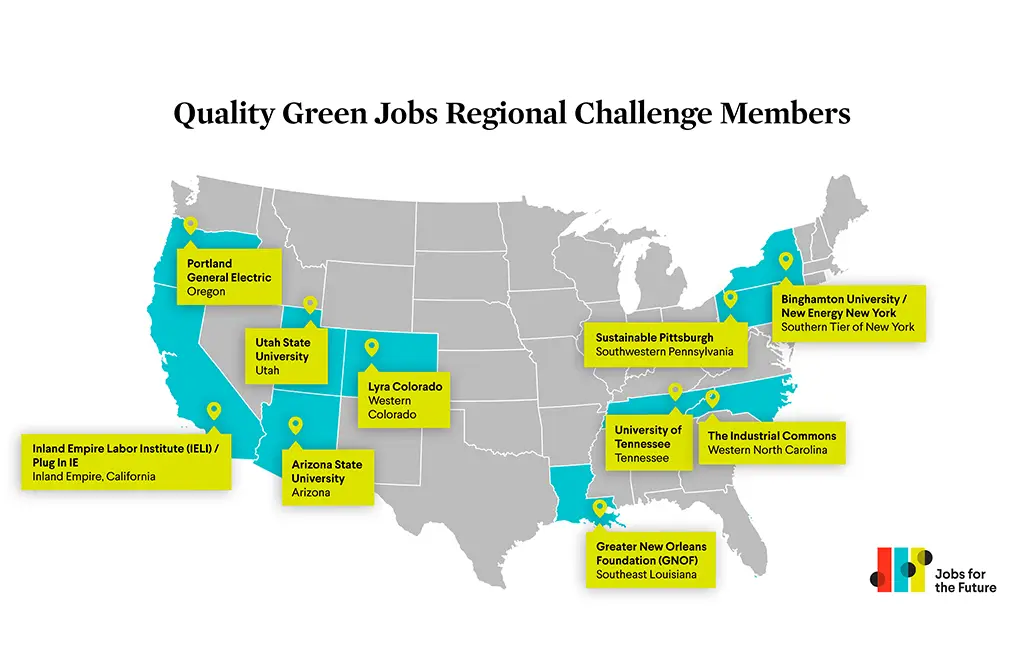
An interdisciplinary team of UT Knoxville faculty members has moved forward in the Jobs for the Future (JFF) Quality Green Jobs Regional Challenge.
The challenge seeks to invest nearly $5 million directly in communities to develop and implement regional quality green job strategies as part of an initiative by Climate-Resilient Employees for a Sustainable Tomorrow (CREST), a career preparation and reskilling initiative of the Ares Charitable Foundation.
The team includes Professor Stephanie Bohon, head of the UT Department of Sociology, Professor Jon Shefner, also in sociology, and Associate Professor Mitsunori Misawa, UT College of Education, Health, and Human Sciences.
They are one of 10 teams that moved forward from the first phase of the challenge, in which their plan qualified for $10,000 participation grants. Their selection for phase two allows them to apply for $75,000 planning grants, with the potential to progress toward more funding.
“Being in phase two means we are able to apply for one of five $750,000 phase three grants,” said Bohon.
Workforce experts project demand for 14,000 new workers in East Tennessee in advanced manufacturing and green construction, while sustainable tourism is expected to grow by 23.4% by 2032.
“East Tennessee faces a labor paradox,” said Bohon. “There are more jobs than people looking for work. At the same time, many people in East Tennessee are not working but could be. A lot of this paradox is attributable to skills mismatch. There is a high demand for workers in the skilled trades—machinists, tool and die specialists, carpenters, and so forth—but few people get that kind of training.”
By advancing in this challenge, the UT team can explore ways to reach Tennesseans who are left out of the job pipeline so that they can get the training they need to get good jobs. They will also work with service providers to make transportation, childcare, and other obstacles less of a barrier to working.
“At the same time, we are interested in reducing environmental damage by focusing on so-called “green” jobs—those that use cleaner practices and produce less environmentally harmful products and services,” said Bohon. “We have a knowledgeable team of UT and local partners, and we are excited to begin the work.”
These jobs diminish the use of fossil fuels, remediate climate damage, and increase the efficiency of energy use through manufacturing, design, and implementation of innovative products and processes and through revising traditional skills and processes to nurture the green transition.
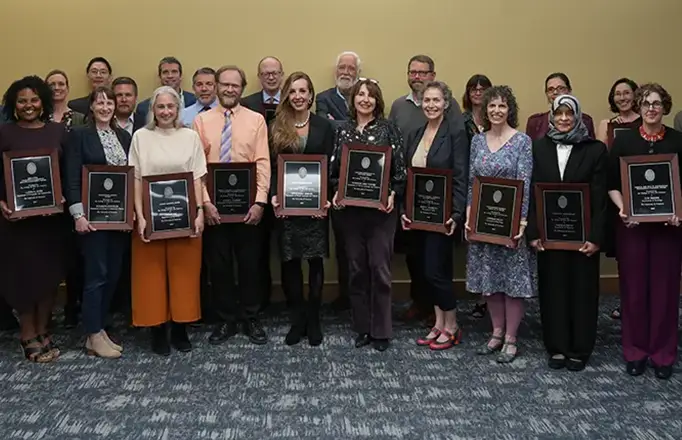
Brown, Presser Honored at Annual College Faculty Convocation
Professors Michelle Brown and Lois Presser received awards for excellence in research and outstanding teaching during the 2023 College of Arts and Sciences Faculty Convocation.
Michelle Brown, Professor
Excellence in Research & Creative Achievement Awards: Senior
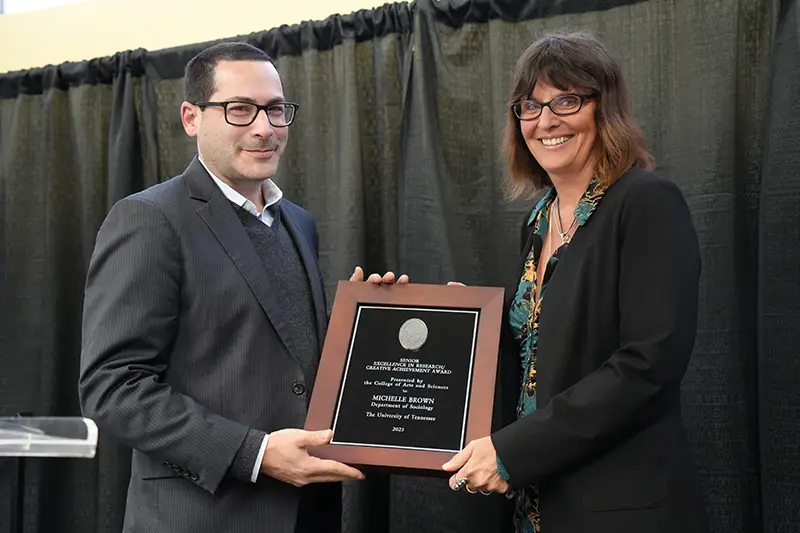
Brown is an acclaimed visual criminologist who joined the University of Tennessee in 2011, received early tenure, and was promoted to professor in 2018. She is an excellent researcher who has published two books on criminology and culture and has another book under contract, all with NYU Press, along with 50 other peer-reviewed pieces.
Brown edited the Palgrave MacMillan Crime, Media, and Culture book series and was editor of the Sage journal Crime, Media, Culture. Very notably, she served as the senior editor of The Oxford Encyclopedia of Crime, Media, and Popular Culture, which received Library Journal’s Best Reference Work Award in 2018.
In addition to a Chancellor’s Award for Teaching and the College’s Diversity Leadership Award, she has also received the University’s Jefferson Prize along with the College’s Award for New Research in the Arts and Humanities. The American Society of Criminology named Michelle Brown the Critical Criminologist of the Year in 2016.
Lois Presser, Professor
James R. and Nell W. Cunningham Outstanding Teaching Award
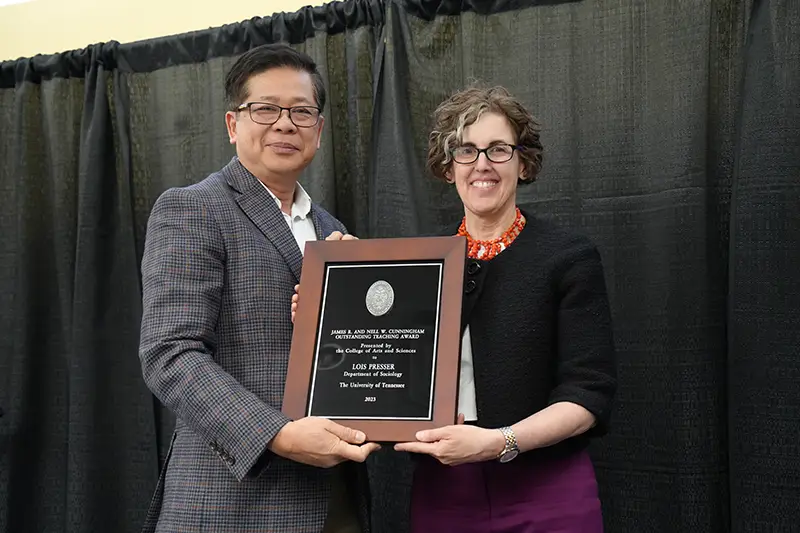
Presser’s nomination came at the urging of our graduate students, who refer to Presser as “one of the most inspiring and dedicated professors” with whom they have worked. They especially note her efforts to hone their research skills, commenting that “she does this by offering extremely detailed feedback on every assignment, creating a space where we feel safe to facilitate discussion, ask questions, and seek additional help whenever and for whatever reason.”
Across her career, Presser has received 21 fellowships and grants, including a Fulbright. She published four monographs, edited five books, and published 61 other papers. Among those papers are several co-written with graduate students who have gone on to remarkable careers of their own. Presser has supervised 17 thesis and dissertation projects and eight senior honors projects. She has taught classes on narrative criminology (an area of criminology that she founded) in Finland, Italy, and Norway. Presser received the Chancellor’s Award for Excellence in Teaching in 2014 and the Excellence in Research (mid-career) award from the College of Arts and Sciences in 2015. Last spring, she was named Outstanding Graduate Director of the Year by the Graduate Student Senate.

Deadric Williams Interviewed as Part of Politico Roundtable
Matt Bruenig is a blogger and president of the left-leaning think tank People’s Policy Project. Stephanie Coontz is director of research and education for the Council on Contemporary Families and the author of several books about gender and the family, including Marriage, A History: How Love Conquered Marriage. Kay Hymowitz is a fellow at the Manhattan Institute, a conservative think tank, and the author of Marriage and Caste in America: Separate and Unequal Families in a Post-Marital Age. Brad Wilcox is a professor of sociology at the University of Virginia and the author of the forthcoming book, Get Married: Why Americans Must Defy the Elites, Forge Strong Families, and Save Civilization, due out in February. Deadric Williams is a professor of sociology at the University of Tennessee-Knoxville who studies race and family structure.
They spent more than an hour in a conversation, moderated by contributing writer Joanna Weiss. They debated the real sources of these concerns about marriage, whether the institution itself has “magical” properties for raising children and if properly supported families of any variety can offer the same advantages.